
News
*
News *
May 5 - 2026
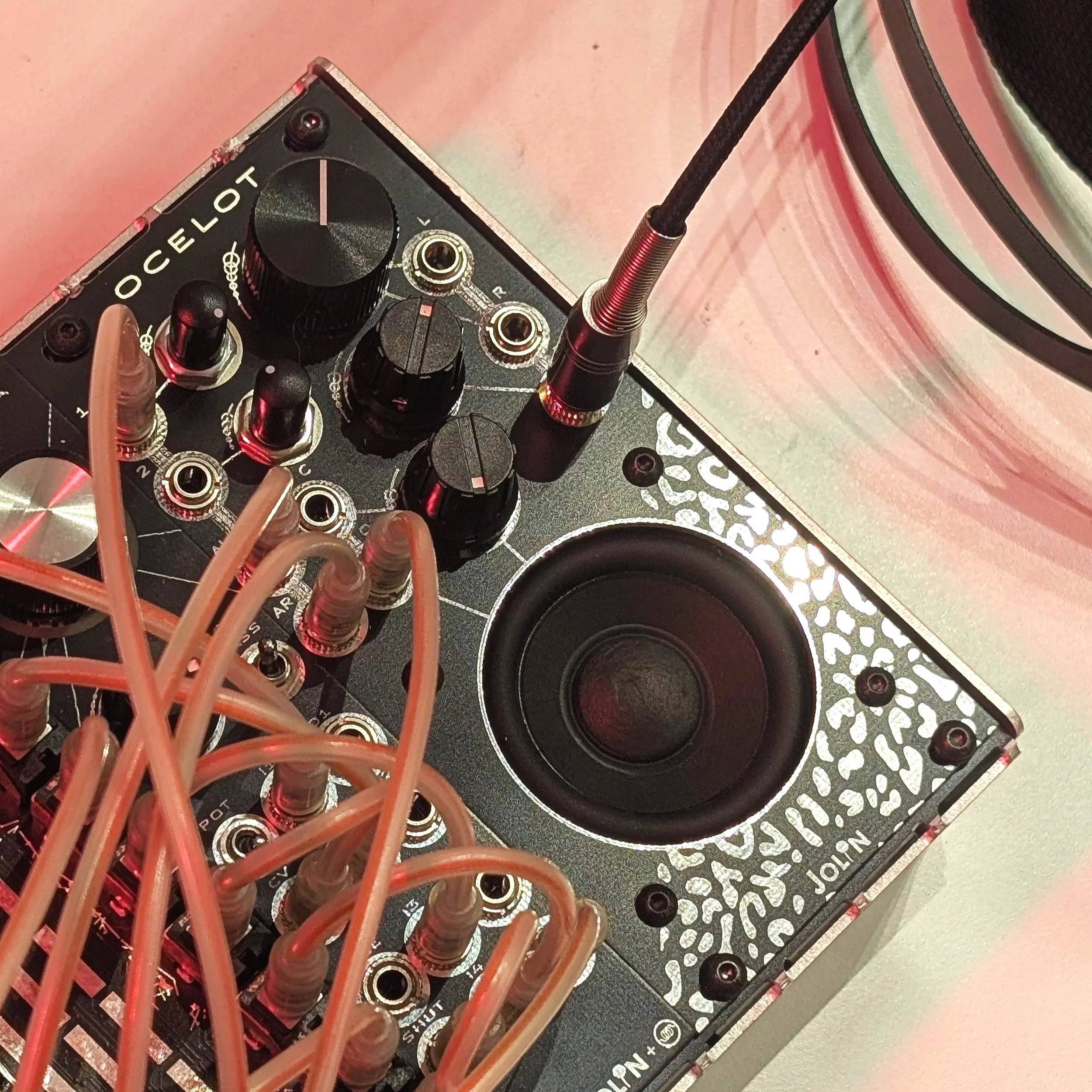
bring your Eurorack systems into the physical world with OCELOT
OCELOT is a compact electroacoustic interface for bringing Eurorack systems into the physical world.
It combines a built-in speaker, contact piezo, compact mixer, balanced stereo outputs and headphone driver in a 12HP module. It can be used as a portable monitoring station, a small mixer for open-air patching, or as an instrument for exploring the acoustic and physical properties of sound.
The built-in contact piezo is normalized to two mono inputs, allowing physical vibrations to become part of a modular patch. At the same time, the integrated speaker can feed those vibrations back into the piezo, creating an acoustic feedback loop that can be shaped with external modules such as delays, reverbs and resonators.
The speaker can also be disconnected from the internal mix and driven directly from an external source, making it possible to pair multiple OCELOTs for stereo acoustic monitoring.
OCELOT is designed as a companion rather than another destination for your signals: a way to listen to, mix, amplify and physically interact with a Eurorack system wherever you take it.
The first OCELOT units are now available to order at jolin.tech and will start shipping in November 2026.
OCELOT is available as a fully assembled module for €229, or as a DIY kit for €169.
April 23 - 2026
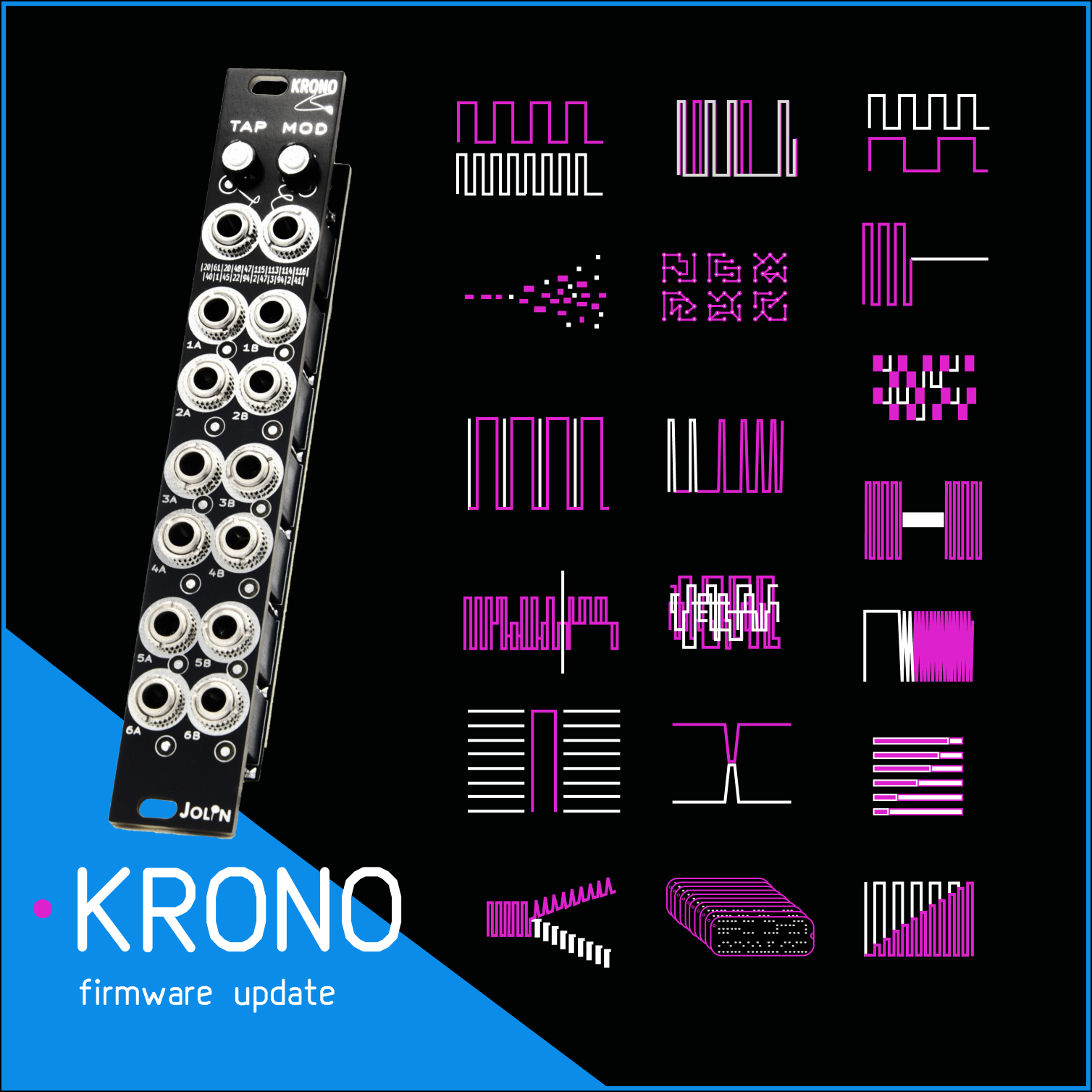
KRONO UPDATE v1.4:
20 new extra modes
KRONO is a 4HP multi-modal programmable clock and rhythm generator designed for algorithmic pattern creation, synchronization, and distributed timing. Built around a compact interface and 12 independent outputs, it combines deterministic structures (ratios, Euclidean, logic) with generative behaviors and state persistence.
Firmware v1.4 is a major expansion of the system.
The mode count is now tripled, from 10 to 30, introducing two new operational banks:
β (11–20): drum pattern variations — stochastic mutation, fills, density control, morphing structures, and loop-based behaviors.
γ (21–30): sequential logic — step-driven and event-based processes including freeze, bounce, probabilistic routing, ratcheting, and phase-consistent muting.
The update pushes Krono further into hybrid territory between clock generator, trigger sequencer, and logic processor, without changing the hardware.
Key additions:
20 new modes (total: 30)
Blink Code for precise mode readout via LED (tens + units)
Fast-Skip navigation (full range in max 10 clicks)
Refined tap tempo: converges every 4 taps using averaged intervals
Improved low-tempo stability and external clock handling
Firmware is open and continuously extended.
Free update.
Flash directly from your browser via USB, mobile supported with an OTG cable:
https://jolin.tech/krono
20 December - 2024
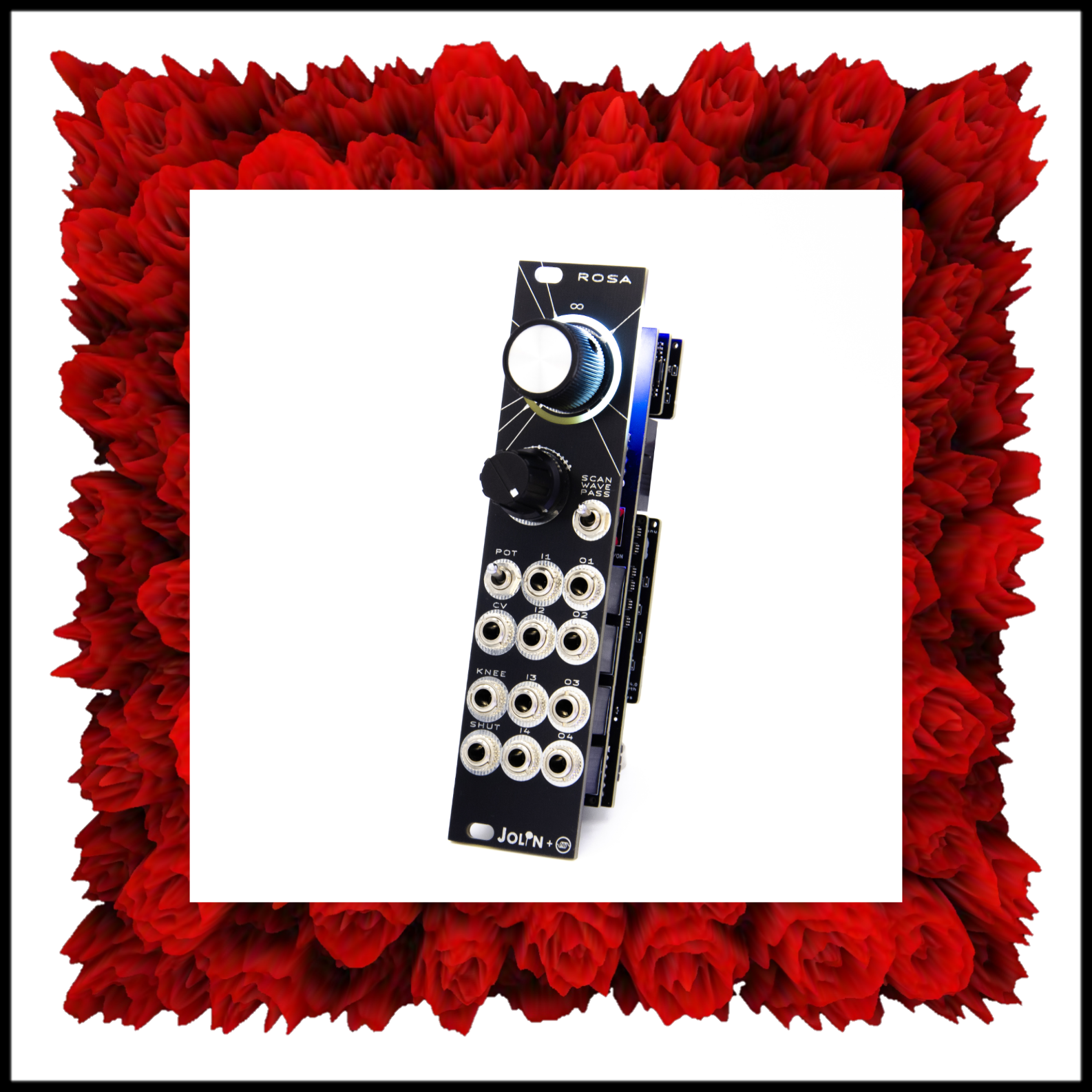
Jolin announces availability of ROSA, a multi-mode crossfader, scanner, and switcher module for Eurorack
ROSA represents the ultimate tool for sound designers and performers seeking fluid transitions and dynamic control. Creatively, it can be used to morph smoothly between multiple inputs, route a single input across multiple outputs, modulate signals dynamically with flexible scanning and control, and switch between signals or outputs for performance variations.
Indeed, it can be used with:
- LFOs (Low Frequency Oscillators) and envelopes — to morph modulation sources across various destinations;
- audio sources — to transition between different oscillators, filters, or effects;
- quadraphonic systems — to distribute signals across multiple speakers for immersive sound;
- rhythmic triggers — to switch between trigger patterns or effects to create evolving sequences.
So how, exactly, does ROSA do what it does?
It includes three distinct modes that allow users to shape and route signals in various ways.
When working in Scan Mode, users can seamlessly morph between up to four inputs — the scanning circuit moves progressively from I1 (input one) to I4 (input four), with the option to loop back to I1 for continuous transitions; by adjusting the KNEE control, users can choose whether the transitions are smooth and gradual or sharp and instantaneous, making it perfect for creating evolving textures or switching between sounds on the fly.
When working in Wave Mode, the four VCAs (Voltage-Controlled Amplifiers) operate independently — although each still follows the same control from the scanning circuit, they are kept separate, so users can independently modulate four different channels, creating complex dynamic changes in a patch.
When working in Pass Mode, a single input is distributed across up to four outputs — if more than one input is plugged, they will all be mixed together, which is ideal for sending the same signal to multiple destinations, like quadraphonic speaker setups or different effects chains; the transition between outputs can be smooth or sharp, providing users with full control over how the signal moves between outputs.
Digging deeper still, the KNEE control shapes how the transitions behave in all modes, letting users switch from soft fades to abrupt jumps, while the SHUT input mutes all the VCAs simultaneously, so is ideal for performance control or rhythmic muting; since the VCAs are linear, amplitude control can be gradual or instantaneous, depending on the nature of the CV (Control Voltage) input. It is worth noting that the CV input is scanned with an attenuvertor — an attenuator that can also invert the signal — and a mechanical toggle switch (set to POT) permits users to select the Infinite Analogue Potentiometer — itself featuring an LED (Light Emitting Diode) ring to indicate which quadrant users are interacting with — that enables seamless circular and continuous morphing between inputs, or CV modulation (when set to CV).
It is fair to say, then, that whether users are creating evolving textures, routing a single input to multiple outputs, or exploring rhythmic variations, ROSA readily adapts to their needs. Needless to say, the fact that it transforms sounds in real time — thanks to those three powerful modes — makes it a must-have module for anyone looking to push the boundaries of modular synthesis.
11 May - 2024
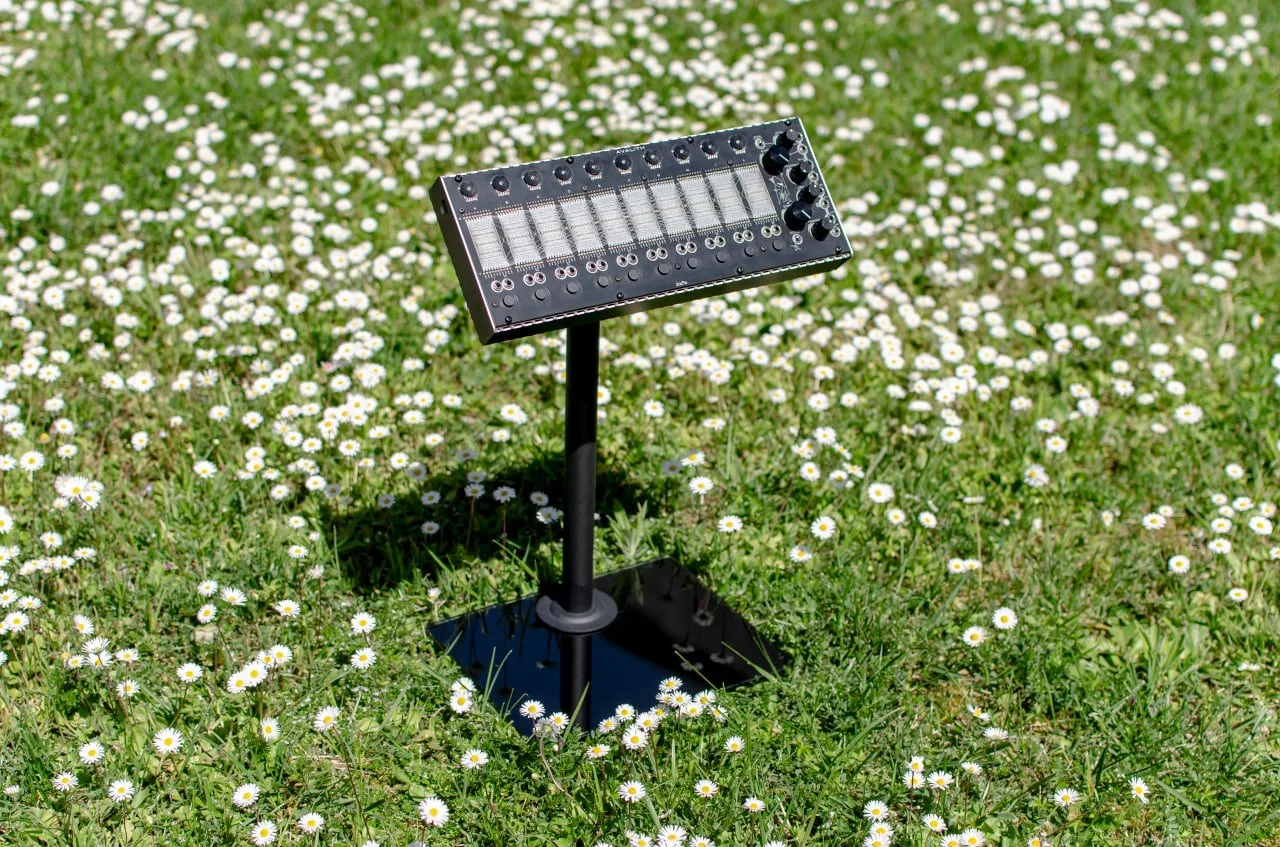
Avalith, a fully analog standalone drone synthesizer
We'd like to introduce you to Avalith, a fully analog standalone drone synthesizer that represents the culmination of several years of research and development in the area of raw oscillators.
///BRIEF///
Overview:
100 Transistor-Based Oscillators with 20 different oscillation frequencies divided into 10 banks of which all have a control potentiometer, starve input, dedicated output and an assignable performance oriented button
Unconditional Versatility: From standalone to a 68HP Eurorack module, it adapts to your performance needs.
Extreme Portability: With innovative USB-C PD power supply (up to 120W) and a lightweight aluminium case, you can take Avalith wherever inspiration strikes.
Flexible Connectivity: A Dupont patchbay for an open design approach, dedicated control inputs and outputs, and more.
Key Features:
100 Raw Oscillators matrix.
4-Pole Resonant Variable State Lowpass Filter with dedicated CV controls.
Hi-Z Preamp with Pre/Post Filter Switch for Auxiliary Input.
High-Quality Headphone Driver.
Custom Riveted Aluminum Design for Strength and durability.
USB C PD power.
suggested retail price: €1189
The synth will be officially unveiled on May 16th in Berlin at Superbooth.
More infos at www.jolin.tech"
///FULL///
AVALITH
100 Raw Oscillators Matrix Drone
AVALITH is a drone synthesizer with a matrix of 100 raw oscillators in an open design configuration framed by a four-pole analog lowpass filter
Avalith operates on the principle of utilizing transistors in a state known as negistors, which is similar to the concept used in its predecessor, Tabor.
The fundamental aim of Avalith is to produce a dense and immersive 'wall of sound' by manipulating pure electrical signals.
This involves incorporating waves of various amplitudes and frequencies and then combining them to create a rich sonic environment.
With 100 open oscillators, Avalith seeks to recreate the creative environment that led to Tabor's inception, allowing users to patch them individually or in banks.
These oscillators are grouped into sets of ten, each featuring frequency controls, internal patch bays, dedicated I/O sockets, and arrays of performance-oriented buttons for customizable functions.
The 'starve' control regulates voltage entering the transistors to induce the negistor state, adjustable at both individual bank and master levels via control voltage.
Its filter system includes an analog variable state 4-pole lowpass filter with resonance and frequency controls, complemented by dedicated CV inputs and an attenuverter for external control.
Avalith also includes a built-in input preamp with routing options, enabling users to incorporate external audio sources into their sound design process.
This feature expands the creative possibilities of Avalith by allowing users to blend external sounds with the synthesized signals generated by the oscillators.
As a standalone desktop unit, Avalith boasts an innovative hybrid power supply utilizing USB-C Power Delivery (20V), with the DC barrel plug doubling as an output to power another compatible eurorack case, making it perfect for outdoor use with a PD power bank.
Additionally, Avalith can also accept power from a standard power brick (from 18V to 24V) if USB-C Power Delivery is not available.
When integrated into a eurorack system, Avalith occupies 68HP of width, with the power selector toggle also serving as an on/off switch.
Features
• 100 Transistor-Based Oscillators with 20 different oscillation frequencies divided into 10 banks of which all have a control wheel potentiometer, starve input, dedicated output and an assignable performance-oriented button.
• A Dupont patchbay with 200 access points for an open design approach.
• 4-Pole resonant variable state lowpass filter with dedicated CV controls.
• Master Starve control with CV input.
• Global envelope and peak CV output.
• Hi-Z Preamp with pre/post filter switch for auxiliary input.
• High-quality headphone driver – 3.5mm stereo jack.
• Standalone with a custom black aluminium riveted case.
• Innovative flexible power: USB C power delivery (20V) or barrel brick (18-24V).
• It can power another small compatible eurorack case or pod (male-male cable included)
• Eurorack ready with front-panel power switch.
Specs
• Dimensions
Standalone: 34.8 length, 13.7 width, 5.5 height (cm).
Eurorack: width 68HP, depth 25mm.
• Current draw +12V 800ma, -12V 300ma.
Demos and other documentation at jolin.tech